Do I Need Flood Insurance?
A Texas home policy excludes flood. Why the cover comes from the NFIP instead, and how to judge the risk at your own address.

Aulona Insurance Group is an independent insurance agency licensed in Texas (Agency License #3481412) with an office in Plano. Luka Cenaj, a licensed Texas agent, is the reviewer of record for every coverage page on this site.
Texas Agency License #3481412 · NPN 22184980 · English & Albanian
On this page7 sections
Flood sits outside a homeowners policy
A homeowners policy excludes flood, so water arriving across the ground is uninsured unless a separate flood policy is already in force. Flood coverage for a Texas home comes from the National Flood Insurance Program (NFIP), run by FEMA, written either directly or through a Write Your Own insurer.
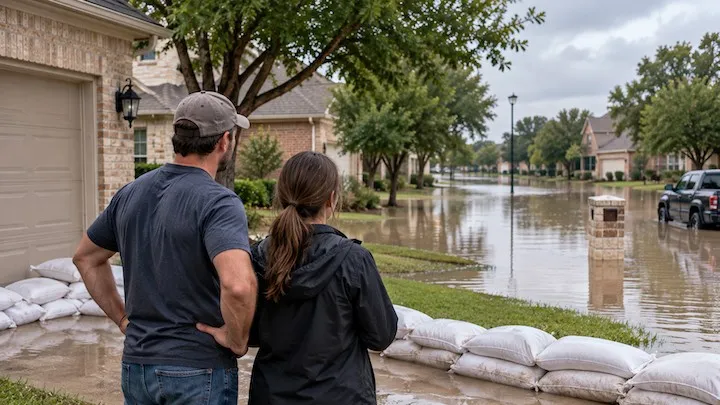
Cause and effect here is short. Rain collects, a creek or a storm drain backs up, water crosses the threshold from outside, and the homeowners policy reads the loss as flood and pays nothing toward it.
A new NFIP policy carries a 30-day waiting period before coverage begins, under the policy terms FEMA publishes for the National Flood Insurance Program. Buying flood coverage because a storm sits in the forecast does not work, and the waiting period exists for that exact reason.
What raises flood exposure on a Texas property
Elevation is the fact that decides flood exposure on a Texas property. Water runs downhill and collects at the low point, and the low point is a question of survey rather than of zoning.
Five site facts raise the exposure:
- Elevation relative to the nearest creek, bayou, storm drain or detention pond
- Ground sloping toward the house instead of away from it
- Upstream development that replaced absorbent ground with pavement and rooftops
- A slab close to street level, on a street that becomes the channel in heavy rain
- A position downstream of a dam or a controlled release
FEMA flood maps show the mapped hazard areas for a Texas address. A flood map is a regulatory boundary drawn from modeling, not a promise about where the water will go.
Why a lender requires flood insurance
A federally regulated or insured lender must require flood insurance on a building sitting in a Special Flood Hazard Area, the high-risk zone on the FEMA flood map, under the mandatory purchase requirement in 42 U.S.C. §4012a. The requirement follows the mortgage rather than the borrower’s own reading of the risk.
Three consequences follow from that rule:
- The lender orders a flood zone determination at closing and again when FEMA revises the map
- A map revision can pull an existing loan into the requirement mid-term
- A lender can force-place coverage on a borrower who does not buy it, on the lender’s terms
Outside a Special Flood Hazard Area the requirement disappears and the water does not. A lender’s silence is a lending decision, never a risk assessment.
The Texas version
Texas floods from rainfall as well as from the coast, and the two arrive under different policies. The National Weather Service Fort Worth/Dallas forecast office and the Houston/Galveston and Austin/San Antonio offices issue the flash flood warnings that precede an inland Texas flood claim.
Wind and flood split apart on the Texas coast. The Texas Windstorm Insurance Association (TWIA) writes windstorm and hail for the 14 first-tier coastal counties and parts of Harris County east of Highway 146 under Texas Insurance Code ch. 2210, and TWIA does not write flood. Storm surge is flood.
Aulona Insurance Group places the coverage this question is about: Flood Insurance in Texas.
What each policy pays for on a wet Texas house
Water damage lands under different policies according to where the water came from, and that one distinction decides the whole question.
| How the water arrived | Homeowners policy | NFIP flood policy |
|---|---|---|
| Rising water from a creek or bayou | Excluded | Covered |
| Street flooding entering the house | Excluded | Covered |
| Storm surge from a named storm | Excluded | Covered |
| Rain through a roof opened by wind | Covered | Excluded |
| A burst supply line inside a wall | Covered | Excluded |
| Sewer or drain backup | Only by endorsement | Only in limited form |
NFIP building coverage and NFIP contents coverage are bought separately. A renter can buy contents alone, and an owner who buys only the building walks away from the furniture.
What does not change flood exposure
Being outside a Special Flood Hazard Area changes nothing about the ground under a Texas house. A map boundary is a regulatory line drawn from a model, and water has never read one.
Five changes move the paperwork and not the exposure:
- A FEMA map revision that moves an address out of the high-risk zone
- A lender dropping the requirement after a refinance
- A house that has never flooded, standing on a street that has
- A high dwelling limit on the homeowners policy, which still excludes flood
- A named-storm deductible, which is a windstorm term rather than flood coverage
The 30-day NFIP waiting period does not bend for a forecast either. Timing is the one part of this decision that cannot be fixed after the fact.
What to have ready before you ask an agent
Start with the address and the flood zone. Everything else about an NFIP quote follows from where the building sits and how high it sits.
Have these in front of you:
- The property address and the flood zone from the most recent determination
- An elevation certificate for the building, if one exists
- Year built, foundation type, and whether there is a basement or crawl space
- Prior flood claims at the address, including claims from before you owned it
- Whether the mortgage requires coverage, and the amount required
Prior claims matter even when they are not yours. A flood history attaches to the building, so the seller’s claim is part of your file.
Have the flood zone and the closing or renewal date to hand, because the NFIP waiting period is fixed and Aulona Insurance Group places NFIP or Write Your Own flood coverage inside it.
What happens when you contact us
Callback, call, placement. No pricing is shown before a licensed agent has spoken with you.
Request a callback
Leave a number and a good time on the contact page, or call the agency directly. We text a code to confirm your number.
A licensed agent calls you
Luka goes through coverage and your situation. No pricing is shown before that call.
Coverage gets placed
We go to the markets we hold appointments with and tell you plainly if we are not the right fit.
Related
