Does Insurance Cover Hail Damage?
Hail is the defining Texas claim. What auto comprehensive pays, how home wind-and-hail deductibles work, and why roof age decides the outcome.

Aulona Insurance Group is an independent insurance agency licensed in Texas (Agency License #3481412) with an office in Plano. Luka Cenaj, a licensed Texas agent, is the reviewer of record for every coverage page on this site.
Texas Agency License #3481412 · NPN 22184980 · English & Albanian
On this page7 sections
Hail damage splits between two policies
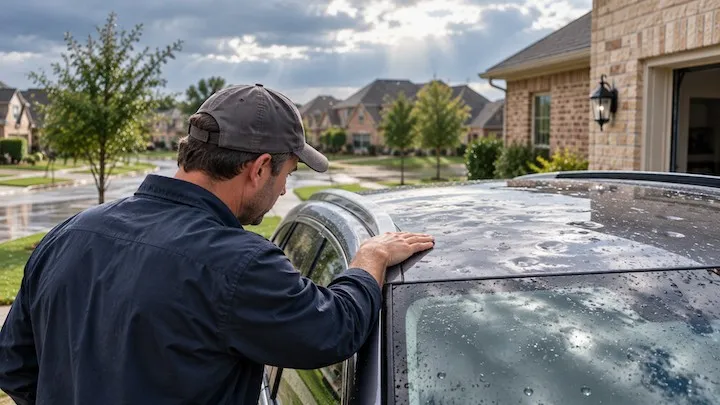
Which policy answers hail depends on what the hail hit. A Texas auto comprehensive coverage pays for hail on a vehicle, subject to the deductible and any cosmetic-damage exclusion on the policy. A Texas homeowners form pays for hail on a house under its wind and hail coverage, on the terms written into that form.
Comprehensive is optional on a Texas auto policy. A vehicle carrying liability only has no hail coverage at all, and a dented hood after a spring storm is the owner’s bill.
The deductible is where the two policies part company. Auto comprehensive carries a flat deductible. A Texas homeowners policy carries a separate wind and hail deductible written as a share of the dwelling limit, so it moves with the dwelling limit rather than staying flat.
How a hail claim runs on a vehicle
Comprehensive pays hail damage to a vehicle less the comprehensive deductible, and the adjuster decides between repair and total loss by comparing the repair estimate to the vehicle’s actual cash value.
A hail claim on a vehicle ends in one of three outcomes:
- Paintless dent repair, where the panels are pushed back from behind and the factory paint stays on
- Conventional body repair with panel replacement and refinishing, on dents too deep or too close to an edge
- A total loss, where the repair estimate passes the vehicle’s value and the insurer pays actual cash value less the deductible
A hail total loss catches owners of newer vehicles off guard. Hail damages every horizontal panel at once, so the estimate climbs across the whole vehicle rather than one corner of it.
How a hail claim runs on a roof
A homeowners hail claim turns on two things the policy decided before the storm: the deductible and the roof settlement basis.
Wind and hail deductibles across much of Texas are written as a share of the dwelling limit rather than as a flat amount, so the deductible rises every time the dwelling limit is revised upward. What Is a Deductible? works through how the figure is applied to a claim.
Roof settlement is the second decision. A policy can settle an older roof at actual cash value, paying the depreciated value of the covering rather than the cost of a new one, and the Texas Department of Insurance home insurance guide explains the difference between the two terms. A roof schedule in the policy sets the age at which that switch happens.
The Texas version
Texas is the hail state, and the insurance forms sold here are written around that fact. The National Weather Service Fort Worth/Dallas forecast office and the Lubbock, Amarillo and Austin/San Antonio offices issue the severe thunderstorm warnings that carry hail, and the NOAA Storm Events Database records the reports afterward by county and date.
The Texas Department of Insurance publishes how wind and hail deductibles work on homeowners policies, including the percentage form. Reading that line on the declarations page before a storm is the difference between a surprise and a plan.
Coastal Texas splits the coverage again. The Texas Windstorm Insurance Association (TWIA) writes windstorm and hail for the 14 first-tier coastal counties and parts of Harris County east of Highway 146 under Texas Insurance Code ch. 2210.
Aulona Insurance Group places the coverage this question is about: Coastal and Windstorm Home Insurance in Texas.
What pays for hail on each kind of property
Hail damage is sorted by what it struck, and each answer sits on a different policy with a different deductible.
| What the hail hit | Coverage that answers it | Deductible |
|---|---|---|
| Car, truck or SUV | Auto comprehensive | Flat amount |
| Roof and siding of a house | Homeowners wind and hail | A share of the dwelling limit |
| Detached garage or fence | Homeowners other structures | Wind and hail |
| Outdoor furniture and a grill | Homeowners personal property | Wind and hail |
| A rental house you own | Landlord DP-1 or DP-3 | Wind and hail |
| Windows and skylights | Homeowners dwelling | Wind and hail |
Two separate deductibles apply when hail hits the house and the vehicle in the same storm. One storm, two policies, two claims.
What a hail policy will not pay for
A cosmetic damage endorsement removes payment for dents to metal roofing, gutters or siding that do not change how the material sheds water. The endorsement is listed on the declarations page, and a hail claim is a late moment to find it.
Hail claims also stop at these:
- Wear, age and deterioration of a roof covering that hail did not cause
- Damage from a storm that predates the policy
- Upgrades a contractor adds beyond restoring what was there
- Interior water damage where the roof opening came from something other than hail
Texas Insurance Code §707.002 requires the insured to pay the deductible on a first-party property claim, and Texas Business and Commerce Code §27.02 makes it an offense for a contractor paid out of that claim to absorb, waive or rebate it. The Texas Department of Insurance takes complaints about a contractor who offers to.
What to have ready before you ask an agent
Start with the roof’s age. Roof age decides the settlement basis on a Texas homeowners policy, which is the figure a hail claim turns on.
Have these in front of you:
- The roof’s age, covering material, and the invoice for the last replacement
- The declarations page, showing how the wind and hail deductible is written
- Any cosmetic damage endorsement or roof schedule on the policy
- Hail claims at the address, including claims filed by a prior owner
- For a vehicle, whether comprehensive is on the policy
The invoice is the item worth finding. A documented roof replacement changes the settlement basis a Texas insurer offers, and an undated memory of the year does not.
Luka Cenaj reads the roof schedule and the wind and hail deductible on a recorded call before Aulona Insurance Group takes a Texas home to an insurer.
What happens when you contact us
Callback, call, placement. No pricing is shown before a licensed agent has spoken with you.
Request a callback
Leave a number and a good time on the contact page, or call the agency directly. We text a code to confirm your number.
A licensed agent calls you
Luka goes through coverage and your situation. No pricing is shown before that call.
Coverage gets placed
We go to the markets we hold appointments with and tell you plainly if we are not the right fit.
Related
